Where AI pays back in a Shopify store and where it does not.
AI will not run your store for you. It will take the slow, repetitive jobs off your team, if you point it at the right ones and measure it on margin rather than activity.
 By Ausaf Khan, Founder & AI Director08/11/2026
Catalogue work first. Judgement stays human.
In a UK Shopify store, AI pays back fastest on catalogue work: product descriptions, SEO titles and descriptions, alt text and Google Shopping data. Next come routine customer questions and weekly reporting. It does not yet replace pricing decisions, brand judgement or the person who decides where your ad budget goes.
The common thread is volume plus rules. Hundreds of listings that all need the same fields filled in are ideal. A one-off decision about which range to push this season is not.
Five jobs AI does well.
1. Thin or empty product listings
Most stores have products with one line of copy, missing SEO fields and no alt text. AI can draft all of it in your brand voice from your own product data and keyword research, at pence per listing. A person approves each one before it goes live.
2. Google Shopping and marketplace data
Disapproved products usually come down to missing attributes: material, size, colour, category, barcode. AI can check every product against a list and fill the gaps from the information you already hold.
3. Finding what needs fixing first
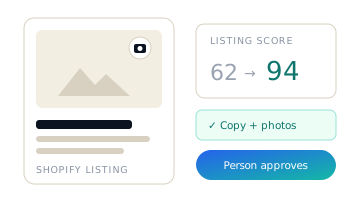
Before writing anything, score the catalogue. The AI Product Studio we built for a major UK retailer gives every product a health score out of 100 from 13 simple checks, so the team works on the listings that matter first.
4. Routine customer questions
Where is my order, how do I return this, do you deliver to Ireland. These follow rules and use data you already have, so an AI assistant can answer them 24/7 and pass anything unusual to your team.
5. The weekly numbers
Pulling sales, ad spend and search data into one view every Monday is a job AI can do reliably, so your time goes on deciding what to do about the numbers, not collecting them.
Three jobs to keep in human hands.
- Pricing and margin decisions. AI can show you the data. Deciding to drop a low-margin product line or hold price against a competitor needs someone who knows the business.
- Brand and creative judgement. AI can draft ten versions of an ad. Choosing the one that sounds like you (and saying no to the nine that do not) is still your call.
- Where the ad budget goes. Ad platforms already use AI to spend your money. You need a person checking that the spend makes a profit, not just sales.
I have seen plenty of ecommerce businesses growing turnover while profit quietly disappeared. More discounts, more bundles, more ad spend. Meanwhile the founder was knackered and could not see why the bank balance did not match the sales.
The fix was never a new tool. It was measuring the right thing. I still report return on ad spend because clients know it, but the number that tells the truth is total revenue divided by total marketing spend, across every channel. Judge AI the same way: did it save hours or protect margin, or did it just create more activity?
Start small. Measure it properly.
- Pick one job. Usually the empty or thin listings, because the before and after are easy to see.
- Write the rules. Your brand voice, words you never use, the fields every listing must have.
- Keep a person in the loop. Nothing goes live without someone ticking it. No bulk approve.
- Measure on outcomes. Hours saved, products now live in Shopping, organic traffic to the improved pages, margin. Not the number of things AI produced.
- Then expand. Customer questions and reporting next, once the first job is paying back.
If you are not sure which job to start with, our Know Your Domain audit maps your store’s processes and scores every task, so you start where the return is highest.
Shopify AI questions.
Can AI write my Shopify product descriptions?
Yes. It is usually the best place to start. Set up properly, it writes from your own product data, keyword research and brand voice rules. A person approves every listing before it goes live.
Will AI-written product copy hurt my SEO?
Not if it is useful, accurate and checked by a person. Search engines care whether a page helps the shopper, not whether a tool helped write it. Thin, copied or generic copy is the risk, whoever writes it.
Do I need a Shopify app or a custom build?
Apps are fine for simple jobs. A custom tool makes sense when you have a large catalogue, strict brand rules or several channels such as Google Shopping and Amazon to keep in step. We tell you which you need before quoting.
How do I measure whether AI is worth it?
Before you start, note the hours the job takes and the result you care about, such as products live in Shopping or traffic to product pages. Compare after 60 to 90 days. Judge it on time saved and margin, not on how much it produced.
Keep exploring.
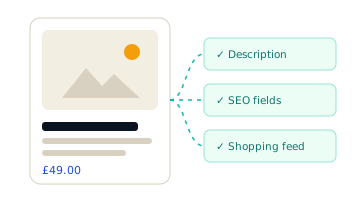 01
AI for ecommerce
Product listings, SEO fields and imagery drafted by AI in your brand voice, approved by your team.
→ 02
AI Product Studio
Shopify listings scored, written and photographed with AI, approved by a person.
→ 03
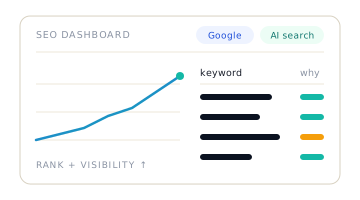
AI SEO dashboard
Search, rank and AI visibility data in one place, with a reason for every keyword.
→How much of your catalogue needs a proper listing?
Ask us to call you back. We will look at your store and tell you honestly where AI would pay back first.